Wednesday, March 11, 2026

Unit 5. Decimal Numbers


During this unit we are going to revise the operations with decimal numbers. 


Unit Index:

1.-What are decimal numbers
2.- How to read and write decimal numbers
3.- Comparing and representing decimal numbers
4.- Adding and subtracting decimal numbers
5.- Multiplying decimal numbers
6.- Dividing numbers with decimal quotient
7.- Dividing decimal numbers by an integer
8.- Dividing decimal by decimal
9.- Rounding decimal numbers
10.- Types of decimal numbers.

Summing up by the teacher B.T.


3.- Comparing and representing decimal numbers on the number line. (video1)


4 & 5.- Adding, subtracting and multiplying decimal numbers (video2)


Multiplying and dividing by the unit followed by zeros... (video3)

Watch the video that explains that:


6,7 and 8.- Division with decimal numbers: these videos help you revising the divisions with decimal numbers (something you have learnt in primary school) (video4)


Video5
 
Video6


Division: give the solution with two decimal positions = round to the nearest hundredth. Watch this video to learn this:  (video 7)


Execises: πŸ“–       

Monday, January 12, 2026

Unit 3. Integers (part 2)


πŸ‘‰ Paragraph 6.- Combined operations with Integers


πŸ‘€  Here you have the videos to revise and watch before doing the exercises: 


πŸ‘€And these videos to correct some of the exercises:


πŸ‘‰ Paragraph 7.- Powers with Integers. Click on the image to open the notes


πŸ““ Find here all the exercises to do:  


Thursday, December 4, 2025

Unit 3. Integer Numbers (part 1)

 Here you have the Index for the unit 3:


UNIT 3. INTEGER NUMBERS

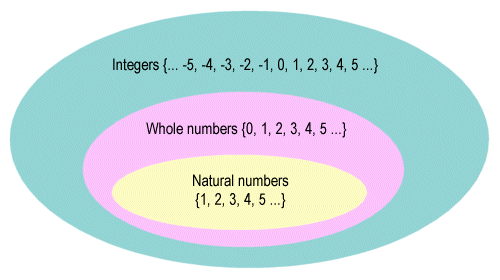
  1. What are Integer Numbers? Negative numbers
  2. How to represent Integer numbers. The order of Integer numbers
  3. Opposite numbers and Absolute value
  4. Multiplying and dividing Integer Numbers
  5. Adding and subtracting integer numbers
  6. Combined operations with additions and subtractions
  7. Powers with Integer numbers
  8. Combined operations involving Integer numbers

Find here some notes taken by students of last year (MΓ³nica and Jimena) and Alejandro who is now in Bachillerato. Thank you all.

πŸ‘‰ Paragraphs 1 - 4 (click on the picture to open the notes)


Absolute value and opposite numbers: πŸ‘€ watch the video: 


How to multiply and divide Integer numbers and how to apply the rule of signs:


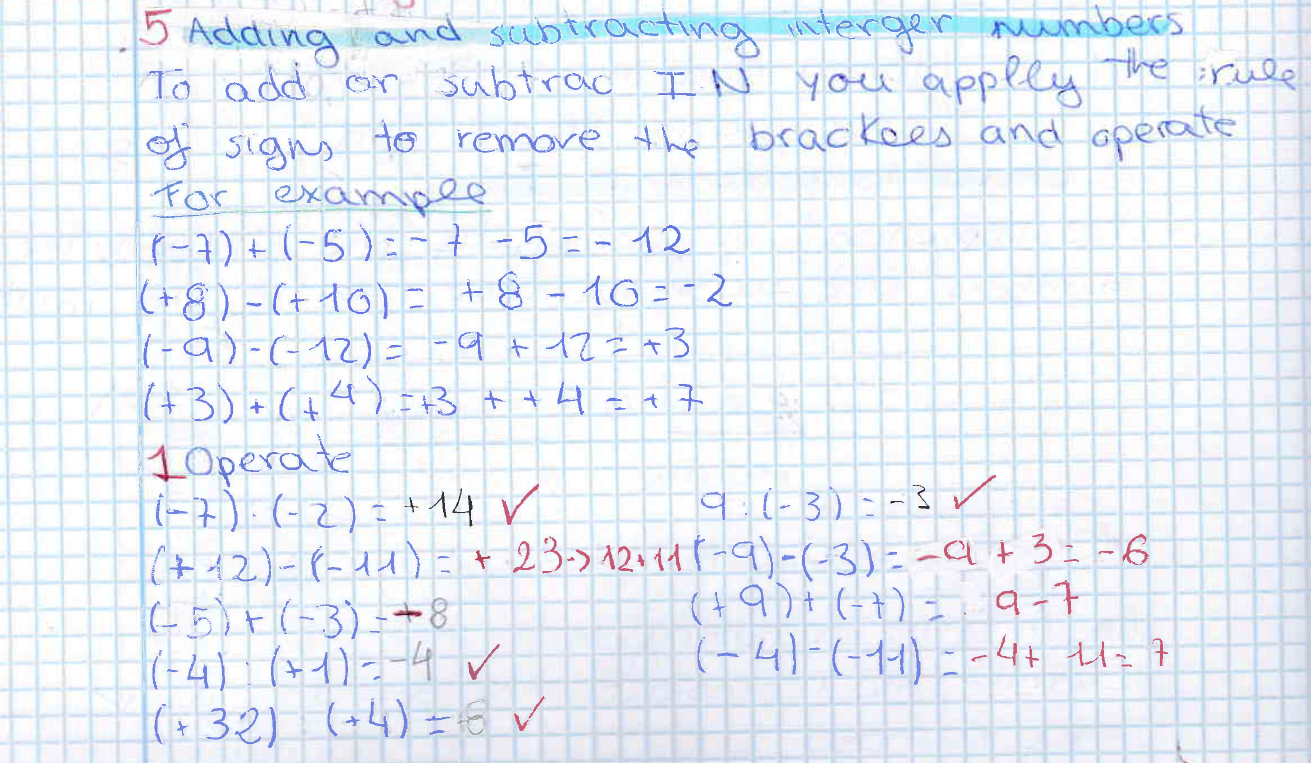
πŸ‘‰ Paragraph 5.- Adding and subtracting Integer Numbers

To add or subtract you have to remove brackets applying the rule of signs and then operate (considering the signs, of course)  here


Combined operations and powers with Integer Numbers (part 3)

Here you can find two videos to revise the combined operations involving Integer Numbers


Powers with Integer numbers:


Wednesday, November 19, 2025

Unit 2. Multiples and factors. Divisibility

 Find here, thanks to two students of ESO (Jimena and MΓ³nica) some clear and useful notes about the unit.

There are also some videos about the main lessons.

πŸ‘‰ Click on the picture to download the notes for:

Prime numbers and divisibility Rules:


 πŸ‘ΏπŸ‘»πŸ‘Ύ  prezi presentation for the test of divisibility πŸ§›πŸΊπŸ‘Ή

Prime factorization Process:


This video may help you to understand the factorization proccess.


Common Multiples and common factors:


Watch these two videos about Common Factors and the Highest Common Factor:


And Common multiples and the Lowest Common Multiple


General method to find the LCM and the HCF:


Watch this video to learn the general method to calculate LCM and HCF


Two examples, calculate the HCF and LCM of 45, 21 and 84
Question What is the HCF and the LCM when there is not any common factor?

Watch the solution here:


Click to download here the Exercises:  18-22         30-32         41-43       63-68    word problems


Saturday, February 1, 2025

Unit 4. Fractions


 UNIT 4. Fractions

1.- What is a fraction and how to read it

2.- Fractions and units  A fraction is a division

3.- A fraction of an amount

4.- Equivalent fractions. Simplifying fractions

5.- Adding and subtracting fractions

6.- Multiplication and division of fractions

7.- Powers with fractions

8.. Combined operations


1.- What is a fraction and how to read it: πŸ““

2.- Fractions and units.  πŸ“˜

4.- A fraction of an amount .  πŸ“˜

Revise some examples watching πŸ‘€ the following  videos:


exercises --->    πŸ“”

5,. Equivalent fractions. Simplify a fraction. πŸ“™

Here you have two very simple videos that help you understanding what equivalent fractions are


6.- Adding and subtracting fractions  πŸ“—

And you can watch πŸ‘€ this video by Professor Dave in native English. The speaking is going to be harder to understand but will help you to get used to real English 


Exercises: πŸ“•

7.- Multiplying and dividing fractions πŸ“—

Watch this video πŸ‘€ to revise how to multiply and divide fractions simplifying before operating if it is posible.


8.- Powers with fractions πŸ“™

This two videos explain how to work with powers of fractions.


9.- Combined operations,     Exercises -- >> πŸ“•   πŸ“—

Watch this video πŸ‘€ where I solve one exercise with products, addions  and subtractions


10.- Word Problems with fractions   - - >   πŸ“ƒ πŸ““


Here, in these videos πŸ‘€ you can find the solution of three of them:


Monday, November 22, 2021

Meaningful Questions

 Science grows thanks to good questions even more than due to the answers... 

Frequently, great contributions to Science started with a brainy change of the question focus...

Lets try it in our lessons...

What is a meaningful question? We call Meaningful questions those questions that have interesting aspects of the subject and show that the student has understood the core of the content.

Examples: 

  • About powers… Since  a0 = 1 and 0b = 0, what is 00 =?
  • About prime numbers… Is it 1 a prime number? Why?
  • About HCF and LCM… When the LCM of two or more numbers is equal to one of the numbers? When the HCF is equal to one of the numbers? 

The students can answer the questions or not, the important thing is that they are able to build the question or at less understand why the question is really interesting and can be considered meaningful.

Reformulating meaningful questions. Once the question is found, the student has to be able to rewrite the question using other words or even a complete different formulation but with the same mathematical meaning.

They can reformulate their own questions or their classmates' questions. 

The simpler, the better the question is.

.